For me, the PANIONS project represents what makes fundamental research so meaningful. Driven by curiosity, it connects people from different backgrounds and cultures, brought together by science. Being part of such an environment is both inspiring and deeply motivating.
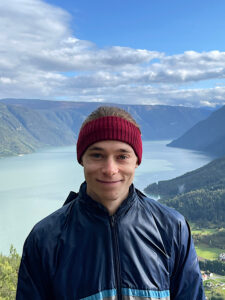
Moritz Lacina
DC6: Cooling and photodetachment of isolated anions under interstellar conditions
Max Planck Society for the Advancement of Science (MPG)
My fascination with physics began in high school, inspired by my amazing teachers. Pursuing a Bachelor’s degree at the Technical University Vienna in my hometown was therefore a natural next step.
After graduating in 2021, I continued my studies with a master’s program in Technical Physics. During this time I had the opportunity to contribute to two research projects that shaped my academic interests. This experience marked my first opportunity to work within an international research group and provided me with valuable insights into scientific collaboration.
In 2023, I spent two semesters abroad at the Università degli Studi di Milano-Bicocca in Italy, where I specialized in astronomy and cosmology. As part of the research group, I investigated galaxy evolution, studying how active galaxies sustain star formation by continuously channelling cold gas toward their centers. A year later, in 2024, I joined the qBOUNCE group at the Atomic Institute at TU Vienna: a fascinating experiment exploiting the unique properties of “ultra cold neutrons” to study the quantum states of neutrons bound solely by Earth’s gravitational field.
For my master’s thesis, I shifted my focus to the field of satellite navigation through a collaboration with Beyond Gravity Austria. Navigation accuracy is achieved by combining signal data from the Global Navigation Satellite System (GNSS) – the same signals used by our devices on Earth – with precise onboard trajectory calculations.
A current area of research in space exploration is the navigation of space vehicles on and around the Moon, where the received GNSS signal strength is approximately 400 times weaker than on Earth, pushing both hardware and software to their limits. My thesis contributed to this effort by implementing an efficient gravity model for onboard trajectory calculations. After graduating in 2025, I continued my employment with Beyond Gravity and am now looking forward to taking the next step in my academic career as part of the PANIONS project.