THIS WEBSITE USES COOKIES
We use cookies to personalise content, to provide social media features, and to analyse our traffic. By choosing 'allow all cookies', you consent to our cookies.
To find out more, read our privacy policy and cookie policy.
Negative ions play a crucial role across atomic and molecular physics, astrophysics and a wide range of technological applications, from fusion energy and accelerator mass spectrometry to space instrumentation and medical diagnostics. Despite their importance, many fundamental properties of negative ions remain poorly understood. This is largely due to the strong electron correlation effects that govern their structure and dynamics, which pose major challenges for both experimental investigations and theoretical modelling.
PANIONS brings together leading experimentalists and theoreticians to significantly advance the understanding of atomic and molecular negative ions beyond the current state of the art. By combining dedicated in-house experimental setups with access to large-scale European research infrastructures, and by systematically benchmarking advanced theoretical models against high-quality experimental data, the network aims to overcome long-standing limitations in the field. The newly acquired knowledge will not only deepen fundamental insight into highly correlated quantum systems but will also support the development and optimisation of key scientific and technological applications of negative ions.
The overarching goal of PANIONS is to improve our understanding of negative ions and their role in nature and technology through an integrated research and doctoral training programme. This ambition is articulated through five Research and Training Objectives (RTOs).
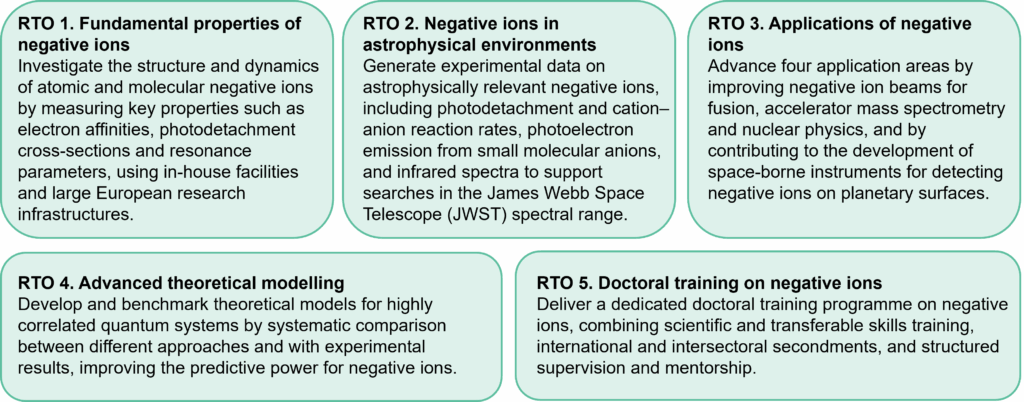
PANIONS implements its objectives through 14 independent but highly collaborative doctoral research projects. These projects span both theoretical and experimental research, addressing systems ranging from the simplest negative ion, H⁻, to complex negatively charged clusters. Each doctoral project contributes to at least two of the research objectives, ensuring strong cross-linkages while minimising interdependencies and risk.
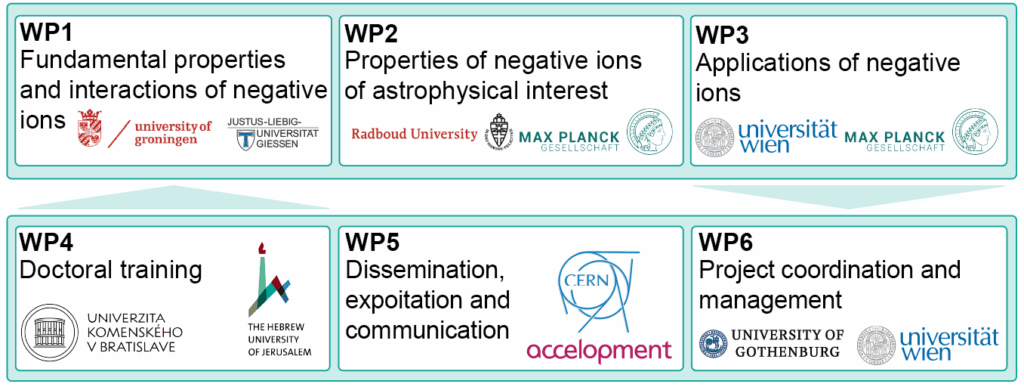
To structure the research and training activities, PANIONS is organised into six work packages. While each work package addresses specific objectives, the programme is designed to foster strong interaction and collaboration among doctoral candidates through joint activities and secondments. Together, the combined results of PANIONS will constitute a major contribution to the understanding of negative ions and their role in the cosmos, with lasting impact on fundamental science and applied technologies.