Insights from the 75th Lindau Nobel Laureate Meeting
The 75th Lindau Nobel Laureate Meeting took place from 28 June to 3 July 2026. Chiara Llinas, PANIONS DC10, shares her experience of the event in the account below.
The meeting
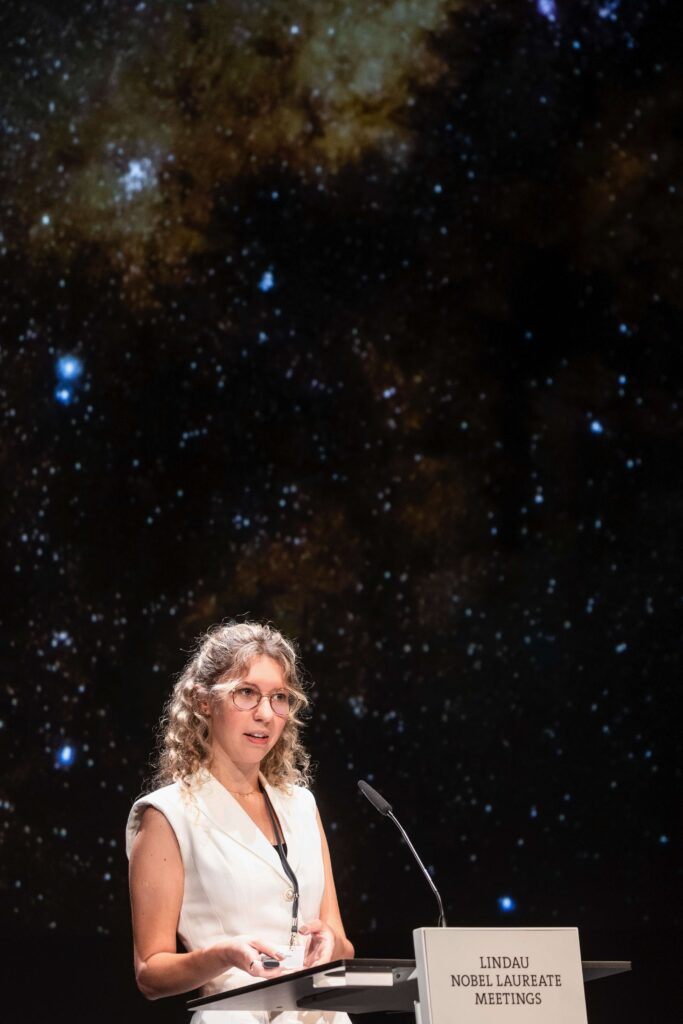
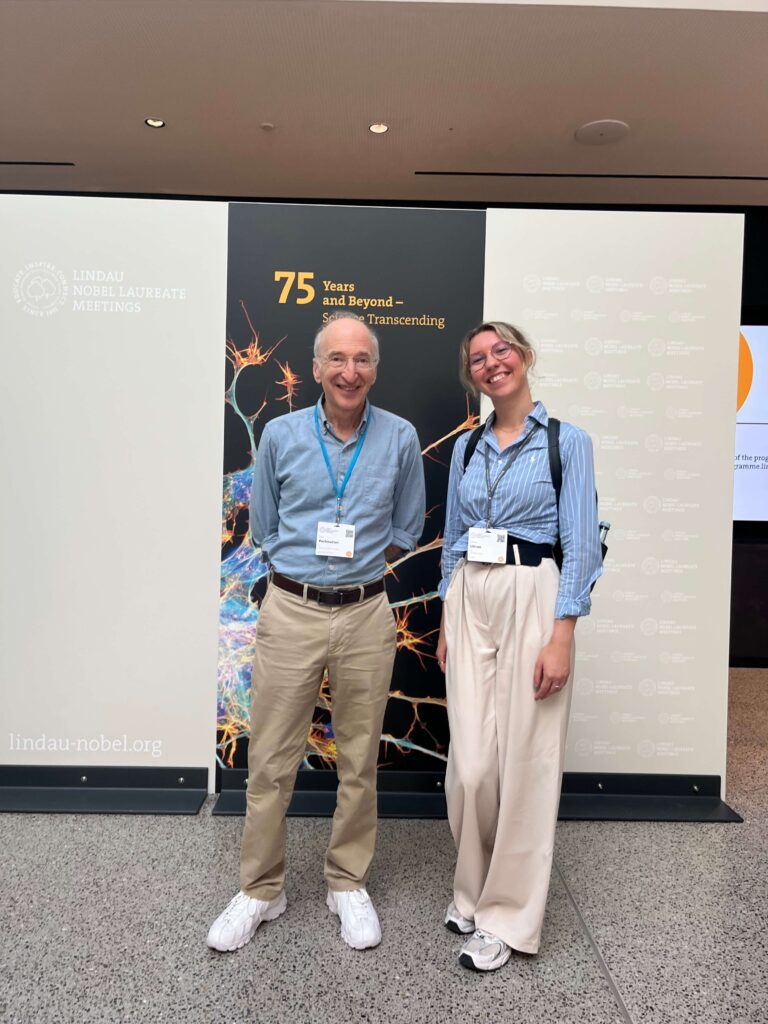
At the Lindau Nobel Laureate Meeting, around 600 young scientists from across the world spend a week with some 70 Nobel Laureates. Not only did I get the chance to discuss with these brilliant minds, but I also had the honour of presenting my own work to this incredible crowd.
What I work on
My project sits at the intersection of nuclear physics, astrophysics and instrument development. Almost every atom heavier than hydrogen was made inside a star. When a massive star ends its life as a supernova, it forges new elements and scatters them into space, and eventually some of that stardust reaches Earth. Because these radioactive atoms are not produced naturally on our planet, they are perfect fingerprints of such stellar events.
But how do we measure something that rare? My work uses Accelerator Mass Spectrometry (AMS), a technique sensitive enough to identify a single atom of interest among more than a billion others, to hunt for these signatures in deep-sea sediments. Reading that archive has valuable astrophysical implications: it aims to contribute to a better understanding of our Universe with a growing sensitivity.
What I bring back
More than scientific lectures, Lindau was a place of discussion, exchange and debate, where across disciplines and cultures the one thing everyone shared was a profound curiosity. Some of the key topics of the week:
What does it mean to understand in the age of AI
How do we rebuild trust in science?
Resilience in research.
Interdisciplinarity and diversity as engines of progress.
I was struck by the openness of the Laureates. People who have reached the summit of their field spoke freely about the years of ambiguity, the failed measurements and the dead ends that preceded the result everyone remembers. As a young researcher, that brings hope, motivation, and a healthier perspective. It reframes the frustrating months as part of the method rather than a sign of failure, a lesson worth more than any single lecture.
Above all, Lindau confirmed what PANIONS is built on. A week of conversations across physics, chemistry, medicine and beyond made it clear that the most interesting questions rarely belong to a single discipline, and that they are best approached collectively. I came back with a renewed sense of how fortunate I am to be part of a European network that turns that idea into daily practice, and with a stronger determination to contribute to it.
This news text was written by Chiara Llinas, PANIONS DC10.